
Many countries in South-Eastern Europe have been experiencing recurring waves of mass protests for years, often leading to the fall of governments and new elections. This cycle shapes the political system – and, despite the resulting instability and political crises, keeps the promise of democracy alive.
Author: Ivaylo Dinev
Labour unrest in the context of multiple crises: a comparative perspective of Europe
By presenting the first comparative data of trade union and workers’ protests since Covid-19, based on local sources, this article attempts to fill a significant gap in the empirical research on cross-country comparisons of labour mobilizations. The findings indicate a high level of labour protest activity, with trade unions driving most mobilizations. While elements of social movement unionism can be found in all analysed countries, their intensity and scope vary significantly. We find two patterns in alliance building: the cross-movement coalition in Italy and Greece, where trade unions, grassroots organizations, and social movements unite in major campaigns and the trade union movement coalition pattern prevailing in Belgium, Bulgaria, and Romania, where confederations and federations primarily ally within a given sector or nationally in large-scale protests, with minimal engagement with other civil society actors. Protest tactics also differ across national traditions. In post-socialist states, strikes have diminished in favour of other forms of social movement repertoire, such as demonstrations and rallies. In contrast, in Belgium, Greece, and Italy, strikes remain a key strategy for the labour movement. Finally, our analysis highlights variations in systemic mobilization and differences in public and private sector protests across countries, with Greece exhibiting the highest level of systemic labour unrest, while other cases focus more on workplace-specific issues; additionally, private-sector protests are more prevalent in Belgium and Italy, whereas large-scale public-sector mobilizations, particularly in healthcare, education, and public administration, dominate in Greece, Bulgaria, and Romania.
Dataset: Protest Event Analysis
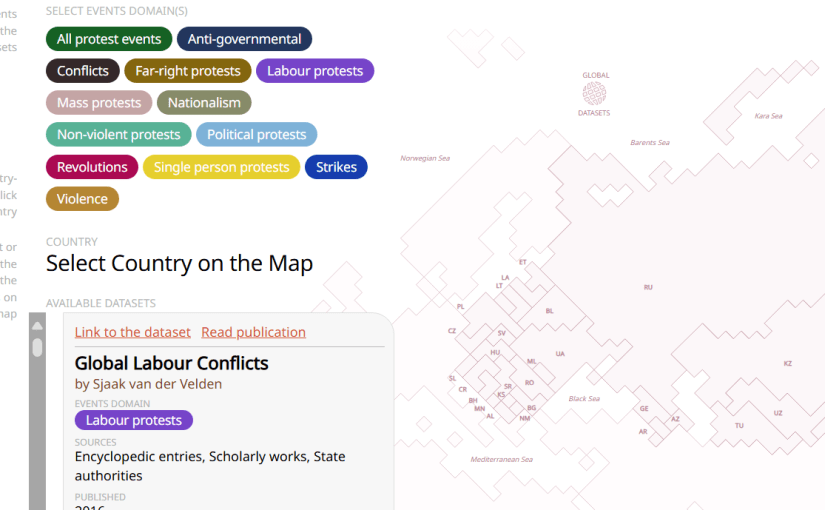
Our platform in KonKoop, ZOiS – Centre for East European and International Studies, presents comprehensive information on 51 accessible collections of protest event data for countries in Eastern Europe, the South Caucasus, and Central Asia.
This includes the countries and time periods they cover, data sources, types of events, research publications utilising the data, references, and (in most cases) links to the original datasets.
1️⃣The primary aim of the database is to deepen our understanding of contemporary and historical societal dynamics across the three regions while fostering critical engagement with the challenges and opportunities of this methodology.
2️⃣All the presented datasets share the same core principle of retrieving information about collective actions from textual sources and converting it into quantitative indicators (e.g. number of events, participants, dates, locations). However, they differ in their methodologies.
3️⃣Most datasets rely on coding news from the local press, online media and news agencies, while others incorporate official reports from state institutions or analyses by civil society organisations. Another key difference lies in the scope of the events covered.
4️⃣Some datasets include all forms of collective action within the studied timeframe, whereas others focus on specific event types, such as political protests, strikes, nationalist rallies or mass protests and revolutions.
The visualisation enables users to select the type of events, time periods, and countries for which data will be displayed.

Chapter: Progressive politics in CEE
New Book Out: Handbook of Progressive Politics
Edited by Alice Mattoni | Published by Elgar Publishing
How has progressive politics evolved in Central and Eastern Europe (CEE) in the last three decades? In our chapter with Julia Rone, we explore progressive mobilization across Bulgaria and Romania, the Baltic states, the Visegrád Group, and the Western Balkans. Our analysis outlines both general common trends and particular developments in different groups of countries.
Chapter: Bulgaria—Protest Movements Transforming the Party System
How did the protests in 2013 and 2020 impact Bulgaria’s party system? This is the key question my colleague Dragomir Stoyanov and I explore in our latest research. We analyze various mechanisms through which people can influence political change.
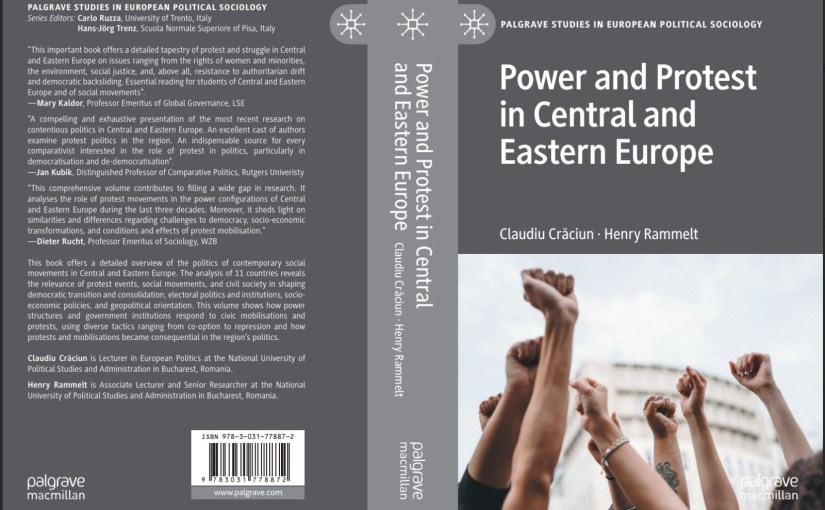
Our chapter on Bulgaria is part of the book “Power and Protest in Central and Eastern Europe” (published by Palgrave Macmillan), edited by Claudiu Crăciun and Henry P. Rammelt. The book examines protest movements in 11 countries across the region.

Protests in Serbia
Students in Serbia have formed the largest student movement in contemporary Europe, growing into a powerful force with support from diverse social groups.
The text was first published on the ZOiS website and later translated and re-published by media outlets in multiple languages around the world.
 Ivaylo Dinev